AI Picks and Shovels (Arc 1: Forging the Brain): Advanced Micro Devices (NASDAQ: AMD) — The Challenger
Nvidia designs the brain. This is the only credible merchant-silicon company trying to sell hyperscalers a different one — off the shelf, no co-design contract required. Arc 1 closes with the fight that decides whether “second source” becomes a real category or stays a talking point.

Picks and Shovels Series | Arc 1: Forging the Brain | Part 3 of 3
Two weeks ago this arc opened at the foundry that manufactures nearly every advanced chip on the planet, on commission, for whoever can book the wafer capacity. Last week it moved to the firm that takes that manufacturing capacity and spends it building bespoke silicon for six named hyperscalers — chips with one customer’s name already on them before they are taped out.
This week closes the arc with the only company in it that sells a general-purpose GPU off a price list — no multi-year marriage required to get a chip in the door. Aimed squarely at the company that has owned this entire category for a decade.
Advanced Micro Devices (NASDAQ: AMD) is the challenger. Not to a customer. To Nvidia.
Merchant Silicon, Round Two
Broadcom’s business only makes sense once you understand it sells nothing you can simply order off a price list — every XPU is a multi-year engineering marriage with one buyer. AMD sits on the opposite side of that divide, in the same camp as the company it is chasing.
Like Nvidia, AMD is fabless. It designs chips and has TSMC build them, on the same advanced nodes and through the same CoWoS packaging lines covered in Part 1. Like Nvidia, it sells a general-purpose GPU that any buyer can purchase, drop into a data centre, and point at whatever workload they need to run. The programmability is the product, not a bespoke fit to one customer’s model architecture.
The architecture is merchant. A SKU can still be tuned — Meta’s deal includes a custom MI450-based accelerator on the Instinct family, not a from-scratch XPU — but that is still a different business from Broadcom’s. A custom Broadcom chip only has to beat one alternative for one customer’s job. A merchant GPU has to be good enough, broadly enough, that a buyer chooses it over Nvidia’s own part with no lock-in to fall back on if it is not.
That is a fundamentally harder business to win than Broadcom’s. AMD has done a version of it before. It spent the 2010s doing exactly this to Intel in server and desktop CPUs, clawing share back from a dominant incumbent one generation of EPYC and Ryzen at a time. The pitch now is that it can do it again, in GPUs, against Nvidia — the only credible merchant alternative on the board, even if Intel, startups and China-only stacks exist on the edges of the category.
The MI-Series Roadmap: From Chasing to Shipping
The current generation — MI300X, MI325X and MI355X — is what got AMD taken seriously as a data-centre GPU vendor in the first place: TSMC’s advanced nodes, CoWoS packaging, and memory that scales up to 288GB of HBM3E on the MI355X. The pitch has been consistent. Undercut Nvidia’s list prices. Close enough of the raw performance gap on inference that a second-source conversation can start.
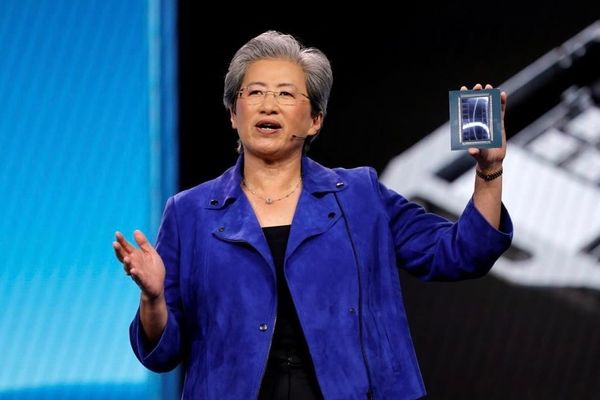
The generation that matters for 2027 is MI400, and specifically the MI450 family that anchors it. AMD is not shipping the chip alone. It is shipping a rack. Helios, built on the systems-design business AMD kept after closing the ZT Systems acquisition in March 2025, connects 72 Instinct MI455X GPUs with 6th Gen EPYC “Venice” CPUs and Pensando networking to work as a single accelerator. That is the rack-scale approach Nvidia popularised, rebuilt on AMD silicon and, deliberately, on open Ethernet rather than a proprietary GPU fabric.
At Citi’s Global TMT Conference on 8 September, CFO Jean Hu put numbers under the ambition. AMD expects data-centre revenue to roughly double to around US$70 billion in 2027, with AI GPUs contributing in the low-US$40 billions and server CPUs the rest. That is a figure that did not exist in any AMD guidance a year ago. It rests on Helios and MI450 landing on something close to the current timeline. Management told the same room that production MI450 shipments have begun in the third quarter of 2026, with a heavier ramp guided for the fourth quarter and another step-up in early 2027. That is guidance, not a third-party confirmation of volume. The distinction matters later.
Context for how far the company has already come sits in the 4 August Q2 result. Total revenue hit US$11.5 billion, up 50% year-over-year. Data Center revenue more than doubled to US$6.7 billion, up 107%, and — for the first time — became the majority of the company: 58% of total sales, versus 42% a year earlier. EPYC server CPUs booked a fifth consecutive record quarter. AMD guided the September quarter to roughly US$13.0 billion, plus or minus US$300 million, 41% growth at the midpoint and ahead of where the Street had it.
Two things that number does not tell you. First, AMD still does not break Instinct GPU revenue out of the Data Center segment. The US$6.7 billion is EPYC plus Instinct plus the rest of the server stack, so the “AI GPU challenger” story is partly inferred from design wins and guidance rather than from a disclosed accelerator run-rate. Second, not every line moved the same direction. Gaming revenue fell 31% year-over-year, to US$779 million from US$1.12 billion. That is a genuine soft spot, and it is not irrelevant to the AI story: the non-AI AMD still has to fund itself while the multiple pretends the mix shift is already complete.
ROCm vs CUDA — Still Behind, Visibly Closing
Hardware is only half of why AMD has struggled to take real share from Nvidia. The other half is CUDA, Nvidia’s roughly two-decade-old software platform, which comes with a depth of libraries, tooling and trained developers that a hardware spec sheet cannot match on its own.
AMD’s answer is ROCm — Radeon Open Compute — an open-source alternative to CUDA’s proprietary stack that AMD has been building for about ten years, a reputation for being genuinely harder to work with. That reputation is becoming dated faster than the market has priced in.
The evidence is now the cadence, not the brochure. In the past year ROCm has moved to frequent public releases, added a supported path to train locally on consumer Radeon GPUs with a pip-install of PyTorch, and reached 7.14 and 10.0 by this month. The stack that used to need driver workarounds is no longer that stack.
In July AMD added the other half of the bet: ROCm.ai, a coding-agent layer for install, debug and tune, guided to land in August. The aim is not to out-document CUDA. It is to make the stack less punishing to use.
None of that makes ROCm equivalent to CUDA. For the largest, most demanding training runs, Nvidia’s tooling still tends to be the safer default. What has changed is the shape of the gap. It used to be existential. It is now closing fast enough that a growing list of hyperscalers are willing to run production workloads on both stacks in parallel — which is precisely the dynamic the rest of this piece is about.
The Hyperscaler Scorecard
AMD does not disclose a customer revenue split any more precisely than Broadcom does. What is on the public record is this.
OpenAI. Up to 6 GW of AMD GPU capacity across multiple chip generations. Warrant for up to 160 million AMD shares — roughly 10% of the company — at US$0.01, vesting on deployment and share-price milestones through October 2030. First 1 GW tranche of MI450-class hardware guided for the second half of 2026.
Meta. Up to 6 GW across multiple generations, including a custom MI450-based accelerator co-engineered for Meta’s workloads. Same warrant shape as OpenAI’s: up to 160 million AMD shares at US$0.01, vesting on gigawatt and price milestones, exercisable through February 2031. Roughly 1 GW of MI450-class hardware also guided to start in the second half of 2026.
Anthropic. Up to 2 GW of MI450 Series GPUs for Helios deployments, with the first gigawatt guided for the first half of 2027. Multi-year engineering collaboration to use Claude on ROCm development. The other half of the deal runs the other way: AMD has committed to invest up to US$5 billion in Anthropic. OpenAI and Meta received paper in AMD. Anthropic is receiving capital from AMD. Same industry pattern, opposite direction.
Microsoft. Helios on Azure. Microsoft will deploy the rack-scale platform to power frontier-model inference for its own models, its AI customers and Azure AI services, alongside new EPYC “Venice” VM families and a broader Pensando DPU rollout. Shipments to Microsoft are guided for the second half of 2026. No headline gigawatt figure has been disclosed. The customer is not a rumour.
Oracle. Named as the first hyperscaler slated to offer a public AI supercluster on 50,000 MI450 Series GPUs, with deployments guided to begin in the third quarter of 2026 and expand in 2027. Earlier, and more concrete, than the “early-stage” label this customer sometimes gets.
HUMAIN. The Saudi PIF-backed sovereign AI platform now has Instinct MI355X systems live in the Kingdom with Cisco, selling compute as a service. The original collaboration targeted up to 500 MW over five years; the next disclosed phase is up to 250 MW of additional infrastructure on the MI400 series from 2027. Smaller than the frontier-lab headlines. Already in production, which several of those headlines are not.
Combined, OpenAI and Meta alone represent 12 GW of up to committed demand. Translating gigawatts into GPU counts is imprecise — it depends on the generation and the cooling design — but the direction is unambiguous, and the warrant structures are worth sitting with. AMD is not just selling chips to OpenAI and Meta. It is handing them a reason to want AMD’s stock price to go up and the gigawatts to actually ship. That is a different sales relationship from a standard purchase order. It is also the same circular pattern now running across the industry in both directions: customers holding supplier paper, suppliers putting capital into customers.
One deal that does not belong on a demand scorecard: Core Scientific. On 28 July AMD signed 15-year leases for about 530 MW of US data-centre capacity across five sites, with expansion rights that can take the relationship to 2.5 GW, so that AMD’s customers have halls and power in which to land Helios. That is supply-side infrastructure, not a 2.5 GW GPU order. Different claim. Different risk.
Market Share and the Margin Gap
Two numbers frame where AMD actually sits today, and they cut in different directions.
Share. Most independent estimates put Nvidia’s share of AI accelerator revenue somewhere in the 80–86% range in 2026, down from north of 90% two years ago. AMD is the clear number two among merchant-silicon vendors, at an estimated 5–8% and climbing — with Broadcom’s custom-ASIC business, covered last week, carving out a separate double-digit slice that is not really competing on the same axis at all.
Margin. This is where the gap is starkest. Nvidia’s GAAP gross margin on its latest quarter was 75%. AMD’s non-GAAP gross margin sits in the mid-50s — 56% in Q2, guided at about 56% again for the current quarter — and its GAAP figure is lower, at 54%. Nvidia’s most recent data-centre quarter, the period ended 26 July, was US$89.0 billion. The quarter before that was US$75.2 billion. Against AMD’s US$6.7 billion Data Center print, that is still roughly thirteen times larger on the latest comparable quarter, and more than eleven times on the one before it. That is the scoreboard a bull has to argue past: AMD is growing faster off a smaller base, but it is not yet pricing like a company with pricing power.
The market’s read on that gap is visible in the stock. AMD closed 11 September at US$516.13 — off its 30 June closing high of US$580.91, but still up well over 100% year-to-date and more than 130% across the past six months, with a market capitalisation around US$843 billion. Trailing GAAP earnings multiple sits above 100 times. Forward multiples move with the estimate set — some screens still print a rich next-year figure, others have already pulled next-twelve-months earnings up toward the mid-40s times after this year’s revisions — but the point does not move with the screen. This is not a valuation that rewards a good quarter. It is one that demands the Helios ramp, the MI450 shipments, and the US$70 billion 2027 data-centre guide all land roughly on schedule, with limited room for a Gaming-style soft patch to show up somewhere in the AI numbers instead.
Why the Second Source Doesn’t Need to Win to Matter
Here is the thing this arc has been building toward: none of Part 1 or Part 2’s companies actually need AMD to beat Nvidia. They just need the fight to be real.
TSMC manufactures AMD’s Instinct chips on its most advanced available nodes and packages them through the same CoWoS lines that build Nvidia’s GPUs. TSMC’s factories do not care whose logo is on the die. Every wafer AMD books for MI450 production is incremental demand stacked on top of Nvidia’s own bookings, not a substitute for them — and CoWoS capacity is already sold out into 2027 regardless of how the market-share number moves.
Broadcom’s Tomahawk and Jericho switching silicon, plus its optics and DSPs, sit inside a Helios rack exactly as readily as they sit inside an Nvidia-based cluster. Networking silicon is agnostic to whose GPU it is connecting. And if a hyperscaler eventually decides neither merchant GPU maker’s roadmap fits its workload, Broadcom’s custom-XPU business — the subject of last week’s piece — is sitting right there as a third path entirely.
The hyperscalers themselves are not buying AMD chips because they have concluded Nvidia is wrong. They are buying them because a credible second source is itself the product: leverage against a single supplier’s pricing and delivery schedule, not just raw FLOPS. That is the actual reason OpenAI, Meta and Anthropic are running live commitments to both companies in parallel instead of picking a side. Microsoft putting Helios on Azure next to a much larger Nvidia fleet is the same logic with a cloud-services wrapper.
Whichever of Nvidia or AMD ships more silicon in 2027, TSMC manufactures the wafers and Broadcom wires the racks together either way. That is the whole thesis of this arc, in one paragraph.
The Aussie Angle
Here is a live case study most US-centric AMD coverage never mentions: a Sydney-founded company that is currently betting its AI infrastructure business on the single-vendor dependency this arc exists to solve.
IREN — originally Iris Energy, a Sydney-based Bitcoin miner — has spent the past two years converting its data-centre fleet into AI cloud infrastructure, and it has done that almost entirely on Nvidia hardware. The installed base runs on H100s and H200s. The live capex does not. IREN’s Microsoft contract is a five-year, US$9.7 billion GPU cloud agreement built around Nvidia GB300 NVL72 systems at Childress, Texas. In 2026 it separately ordered more than 50,000 Nvidia B300 GPUs, and in May it signed a US$3.4 billion AI cloud services deal directly with Nvidia — under which IREN handed Nvidia a five-year warrant to buy up to 30 million IREN shares at US$70. Revenue run-rate, delivery timeline and unit economics currently ride on one supplier’s roadmap, pricing and production schedule, almost in their entirety.
It is not a purely offshore story. IREN is now bringing that model home, with an 800 MW data-centre campus planned for Bundey, South Australia — its first Australian footprint, expected to energise in 2028.
Last week made the dependency sharper, not looser. On 9 September Nvidia named IREN among eight Australian partners in a land, power and shell build designed to host Nvidia DSX “AI factories,” targeting up to 2 GW in Australia by 2027. IREN’s own statement tied Bundey explicitly to that Nvidia reference architecture. That is the opposite of dual-sourcing news. It is another hug from the incumbent, on the campus that is supposed to be the company’s first footprint at home.
That is exactly the exposure a genuine second source is supposed to discipline. As AMD’s share climbs and Helios proves itself in production through 2027, the dual-sourcing pressure already showing up at OpenAI, Meta and Microsoft should eventually reach operators like IREN too — better pricing leverage on the next GPU order, a credible alternative if Nvidia’s delivery schedule slips, and a data point Australian investors holding IREN, directly or through their super fund’s international allocation, would do well to watch alongside AMD’s own numbers. It has not happened yet. Last week’s announcement is the reminder.
The Investment Case — In One Line Per Side
Bull case: AMD is the only credible merchant-silicon alternative to Nvidia, with 12-plus GW of disclosed up to commitments at OpenAI and Meta, named Helios deployments at Microsoft and Oracle, a data-centre business compounding at 107% year-over-year, a management team guiding to a doubling of data-centre revenue in 2027, and a software stack that is finally closing a gap that held the company back for a decade.
Bear case: AMD is priced for flawless execution on a first-generation rack-scale product shipping on an aggressive second-half 2026 timeline, against a competitor with roughly twenty points more gross margin, a two-decade software moat, and more than thirteen times the latest quarterly data-centre revenue. Most of the headline gigawatt commitments are milestone-based and unshipped. Instinct revenue is still not disclosed as its own line. A stock on a trailing GAAP multiple above 100 times, with a beta above 2, has very little room for the Helios ramp to slip a quarter.
The honest read: AMD has done the hard part first — it has landed the design wins and the warrants that make OpenAI and Meta financially motivated to see it succeed. What it has not done yet is prove Helios at scale, in production, on the current timeline, at a margin that starts closing the gap to Nvidia rather than just the gap in growth rate. Whether the current multiple pays you for that execution risk is a question every investor has to answer for themselves.
Arc 1, Closed
Three companies, three roles. TSM builds it, AVGO customises it, AMD challenges for the crown — three ways to own AI compute without betting on one design house. The chips get built, customised, and challenged. That is Arc 1, done.
Arc 2 moves up a layer. A cluster of chips — however they were built, customised or challenged into existence — is still just an expensive pile of silicon until it can talk to the chips next to it, remember what it was just doing, and sit somewhere with enough power and cooling to stay switched on. Over the next three weeks we are covering the company that connects it, the company that gives it memory, and the company that houses it.
Next Monday’s company does not build a single GPU — it does not need to. One of its co-founders helped build networking hardware that quietly became part of the internet’s own plumbing decades before “AI cluster” was a phrase anyone used. It is chaired and run by one of the very few women leading a major semiconductor-adjacent company anywhere in the world, and this year it posted its first-ever US$3 billion quarter — built on a very specific fight: convincing the same hyperscalers in this week’s scorecard to rip out a proprietary networking standard Nvidia itself sells, in favour of open Ethernet.
If Arc 1 was about who does the thinking, Arc 2 opens with who does the talking.
Data Sources:
- AMD Q2 FY2026 earnings release, 8-K and call, 4 August 2026; Q3 guide from the same materials
- Jean Hu at Citi’s Global TMT Conference, 8 September 2026
- AMD Advancing AI 2026 materials, 22–23 July 2026; ROCm release notes through 7.14.1 / 10.0.0; Instinct and Helios product specs; ZT Systems close, 31 March 2025
- Company announcements: OpenAI partnership and AMD 8-K, 6 October 2025; Meta warrant terms in AMD’s Q2 FY2026 10-Q; Anthropic partnership, 22 July 2026; Microsoft Azure / Helios, 20 July 2026; Oracle Instinct rollout, 2025–26; HUMAIN / Cisco updates, May 2025 and 1 September 2026; Core Scientific leases, 28 July 2026
- Nvidia 10-Q for the quarter ended 26 July 2026
- TrendForce and sell-side AI-accelerator share estimates, Q1–Q2 2026. Ranges only; not an official census
- IREN filings and deal releases, 2025–26; Nvidia Australian DSX partner announcement, 9 September 2026
- Market data as of 11 September 2026 close
Wall St. Down Under | Australia
Subscribe | wallstdownunder.com.au
Disclaimer: Wall St. Down Under is an independent financial newsletter for informational and educational purposes only. Nothing published here constitutes financial advice, a recommendation to buy or sell any security, or a solicitation of any investment decision. Always do your own research and consult a licensed financial adviser before making investment decisions. Australian investors should consider their own financial situation, objectives, and risk tolerance. Past performance is not indicative of future results.