ASX Blind Spots (Arc 1: The Machines): General Dynamics (NYSE: GD) — The Submarine
General Dynamics builds the nuclear submarines the ASX cannot. Funded backlog is not cash, yard execution is the risk, and AUKUS depends on US capacity. The tax and FX leaks for Australian holders remain the same.

Blind Spots Series | Arc 1: The Machines | Part 2 of 3
This is Part 2 of 9 in the ASX Blind Spots series, and Part 2 of 3 in Arc 1: The Machines. Arc 1 covers machines and haul; Arc 2 will cover US healthcare; Arc 3 will cover software. Last week was the yellow iron on the same mining cycle; this week is a machine the ASX does not manufacture. Arc 1 still has the railroad to come.
At 30 June 2026, financials were 33.33% of the ASX 200, materials 25.54%, and information technology 2.12%. In FY26, materials returned 52.11% including dividends (price return 47.48%). Healthcare fell about 37.4% and information technology about 37.2% in price terms. This series maps nine businesses whose global operations sit outside the ASX’s banks-and-miners concentration, and records what it costs in tax and currency to hold them. Each part asks one question: What does this business do that nothing on the ASX can, and where are the Aussie leaks?
The Submarine
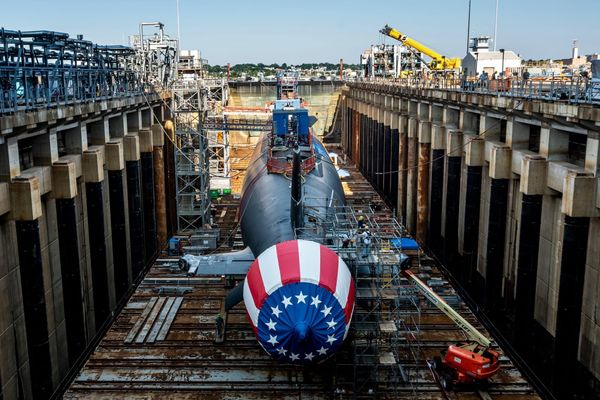
General Dynamics operates in four segments. Marine Systems builds nuclear submarines at Electric Boat (Groton and Quonset Point) for the Virginia-class attack boats and the Columbia-class ballistic-missile boats, jointly with HII’s Newport News. Combat Systems produces armoured vehicles and munitions. Technologies supplies C4ISR and IT services. Aerospace designs and builds Gulfstream business jets.
The essay is Marine Systems. A multi-year US government appropriation is not a commercial order book. Congress authorises and funds shipbuilding over successive fiscal years; the Navy awards multi-year contracts; the yard books the work. The distinction matters. A commercial order book can be cancelled or deferred when a customer’s cash flow tightens. A Navy appropriation can be delayed by a continuing resolution, restructured by a new Congress, or stretched by a schedule slip, but the underlying requirement does not disappear overnight.
Backlog is a fact. It is not cash. At the end of the third quarter of 2026, total backlog stood at $220.3 billion, of which $111.8 billion was funded and $108.5 billion was unfunded (General Dynamics Q3 2026 earnings release and Form 10-Q, 30 October 2026). Funded backlog means the Navy has appropriated the money and the contract is executable under current law. Unfunded backlog is authorised work that still requires future appropriations before it becomes cash. A hull under construction still has to be finished on time, with the right labour and the right material. The difference between a funded line item and a delivered submarine is the yard’s ability to convert hours and steel into a boat that meets the specification.
AUKUS is the Australian door. Australia’s plan to acquire Virginia-class submarines and later build SSN-AUKUS boats depends on the US industrial capacity existing and expanding. Electric Boat and Newport News are the only two yards in the United States that can build nuclear-powered submarines. Australia’s ASC is the sovereign sustainment and eventual build partner for the Australian boats, but it is not a listed prime contractor of this scale and does not currently possess the nuclear-submarine construction capacity. The US yard is where the industrial capacity sits.
The Numbers Behind the Position
| Metric | Figure | Source / note |
|---|---|---|
| Price (6 Nov 2026 close) | $355.90 | Multiple market sources (MarketWatch, financecharts, Morningstar) |
| Shares outstanding | ~269.8 million | stockanalysis.com (as of early Nov 2026) |
| Market cap | ~$96.0 billion | Close × shares outstanding |
| AUD equivalent (price) | ~A$516 | RBA AUD/USD 0.6900 (4 pm, 6 Nov 2026) |
| Trailing P/E | ~20.9 | stockanalysis.com (TTM EPS from company filings) |
| Forward P/E | ~19.5 | stockanalysis.com |
| EV/EBITDA | ~14.7 | stockanalysis.com (TTM) |
| Marine Systems Q3 2026 revenue | $4.96 billion (+21.1% YoY) | GD Q3 2026 release / 10-Q |
| Marine Systems Q3 2026 operating margin | 7.9% (up 80 bp) | GD Q3 2026 release |
| Aerospace Q3 2026 revenue | $3.54 billion (+9.3% YoY) | GD Q3 2026 release |
| Aerospace Q3 2026 operating margin | 14.5% (up 120 bp) | GD Q3 2026 release |
| Total backlog (end Q3 2026) | $220.3 billion (funded $111.8 billion; unfunded $108.5 billion) | GD Q3 2026 release; +100.6% YoY |
| Book-to-bill (Q3 2026) | 6.8-to-1 company-wide; Marine Systems substantially higher | GD Q3 2026 release; segment ratio per contemporaneous coverage |
| Free cash flow (TTM) | ~$5.77 billion | stockanalysis.com |
| Dividend (annualised) | $6.36 | Company / stockanalysis.com |
| Dividend yield | ~1.79% | At 6 Nov close |
| Payout ratio | ~37% | stockanalysis.com |
| Net debt | ~$4.6 billion | Derived: cash ~$4.4 billion, total debt ~$9.0 billion (Q3 2026 balance-sheet figures) |
| 52-week range | $306.77 – $400.00 | Multiple sources |
These multiples sit on a defence-and-aerospace cash-flow profile that converts appropriated marine work and Gulfstream production into cash. They are not measured against equipment-and-services industrial peers.
Base, Bull and Bear
Base. Gulfstream’s 14.5% Q3 operating margin and Marine Systems’ $111.8 billion funded backlog support a defence-compounder multiple, provided the yards hold operating margins near the mid-7% level management has indicated as the baseline once Virginia Block IV cumulative catch-up fades. The Q3 print showed Marine Systems at 7.9% (up 80 basis points) on 21% revenue growth and Aerospace at 14.5%. Free cash flow of roughly $5.8 billion TTM and a 37% payout on a multi-decade dividend record are consistent with a business that converts funded work at a measured pace rather than a pure commercial cyclical. The multiple is supported as long as that conversion rate and the margin mix hold.
Bull. Columbia and Virginia throughput improves as the several thousand shipbuilders hired in 2026 gain proficiency and sequence-critical material deliveries continue the improvement already reported. Electric Boat has stated higher earned hours on Columbia and better supplier cadence. If the yards move from the recent ~1.2–1.3 Virginia boats per year toward the Navy’s two-per-year goal while the first Columbia delivers on a credible schedule, the $111.8 billion funded backlog converts faster and portions of the $108.5 billion unfunded backlog begin to be appropriated. AUKUS-related demand for additional Virginia-class boats adds volume the market has not fully specified in near-term models. The result is multi-year volume growth on an already elevated book, with margins holding or improving as experience accumulates.
Bear. Yard labour remains the binding constraint. New workers take years to reach full proficiency; a skilled-trade shortfall or further wage pressure compresses the already thin marine margins below the mid-7% baseline. A schedule slip on the lead Columbia or a Block V Virginia delays revenue recognition and can trigger cost growth under fixed-price or hybrid contracts. A US budget continuing resolution freezes or stretches appropriations, converting currently funded work back into uncertainty. Meanwhile the Gulfstream cycle that has been supporting the consolidated margin (14.5% in Q3) can soften if business-jet demand cools, removing the offset that currently subsidises the marine story. Execution in the yards, not external geopolitics, is the primary risk.
The Aussie Angle
A US dividend is ordinary income. With a valid W-8BEN the withholding rate is 15%; without it, 30%. There is no franking credit. The cash is taxed in Australia on an AUD basis. The foreign-income tax offset is capped and is unavailable once a fund enters pension phase. The May double-tax guide and the FITO playbook set out the mechanics; they are not repeated here.
Some SMSF investment policies exclude weapons manufacturers. That exclusion is a trustee document the reader either has or does not. A blind-spot holding can be unavailable to a screened fund even when the business case is intact. The ASX does not list a prime contractor of this scale that builds nuclear submarines. ASC is a government-owned sustainment and future-build partner, not a listed equivalent.
Five-Row Card
- ASX substitute, if any. None of comparable scale. ASC is the sovereign submarine company but is unlisted and is not a nuclear-submarine prime contractor.
- Cycle it shares with an Australian holding. Long-cycle defence and shipbuilding appropriation cycles; limited overlap with domestic mining-equipment or resources cycles.
- Tax character of the cash. Ordinary US dividend; 15% withholding with W-8BEN; no franking; FITO-capped; unavailable in pension phase.
- FX cost-base trap. AUD cost base is fixed at purchase. A falling AUD inflates the AUD gain on sale; a rising AUD reduces it. Unhedged.
- Failure mode. Yard labour and schedule execution on Columbia/Virginia; continuing-resolution risk to appropriations; Gulfstream cycle that currently supports consolidated margins.
What’s Next
The next piece treats the haul, not the machine. The Surface Transportation Board’s 18 November comment deadline is the reason the essay is this week. The operating numbers will come from the 22 October third-quarter print, not from a call this week.
Data Sources:
- General Dynamics Q3 2026 earnings release and Form 10-Q (30 October 2026)
- stockanalysis.com (valuation multiples, shares outstanding, free cash flow, dividend)
- RBA exchange rates (6 November 2026)
- Company disclosures on backlog, book-to-bill and segment margins
- Multiple market-data providers for the 6 November 2026 close and 52-week range
Wall St. Down Under | Australia
Subscribe | wallstdownunder.com.au
Disclaimer: Wall St. Down Under is an independent financial newsletter for informational and educational purposes only. Nothing published here constitutes financial advice, a recommendation to buy or sell any security, or a solicitation of any investment decision. Always do your own research and consult a licensed financial adviser before making investment decisions. Australian investors should consider their own financial situation, objectives, and risk tolerance. Past performance is not indicative of future results.