Editorial: The Roadster Flew. Should Your Portfolio?
Tesla flipped a car off an upside-down ramp in Texas. That is an engineering milestone. A halo car with no confirmed price, volume or delivery date is not a scale milestone, and scale is what the stock was already pricing.

On Thursday night in McGregor, Texas, Tesla raced a Roadster up a curved ramp, held it there upside down on a vacuum-fan system, launched it off the top and landed it with air thrusters. It claims 0–60 mph in under one second on a thruster variant (a company demo clocked 0.81 seconds). Nine years after the first reservations, Tesla has still delivered zero of them.
This piece was filed before Friday’s US session opened, so it carries no post-event price.
A Ramp in McGregor
Tesla staged the reveal at SpaceX’s test site in McGregor, near Waco, with a livestream starting at 7:55 p.m. central. Musk, design chief Franz von Holzhausen and vehicle engineering VP Lars Moravy were on stage. The event had already slipped two weeks from 1 October, which Tesla blamed on forecast severe weather.
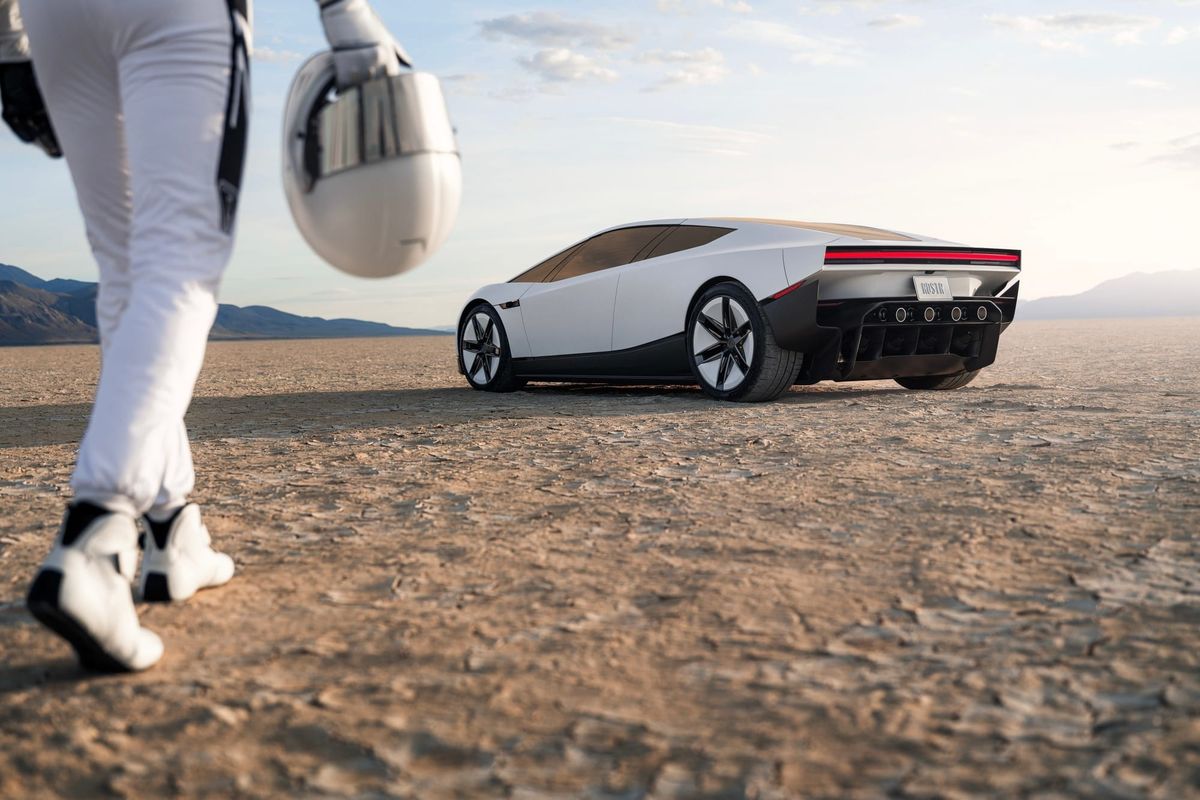
The demo was a white, wedge-shaped Roadster that raced up a curved ramp, clung to it upside down, vaulted off, flipped and hovered briefly before landing. A vacuum-fan suction system held the car to the ramp and compressed-air thrusters righted it for the landing.
Tesla’s headline claim is 0–60 mph in under one second, and it called the car the world’s fastest. Those are company claims. The coverage we found includes no independent test. The sub-one-second figure applies to thruster-equipped versions, not the base road car.
Three variants were listed: a road-ready two-seater (Performance) with a multi-mode suction system, a race-ready two-seater (Thrust) that adds rear cold-gas thrusters, and an invite-only single-seat Rocket version with a full flight system that is not approved for public roads. Production is targeted for 2028.
Two Reveals, Six Weeks
This is Tesla’s second product moment since early September. The first, the Cybercab launch in Austin, moved the product and left the scale question open. The stock’s reaction to that one is the only precedent we have.
| Cybercab, 3 Sep | Roadster, 15 Oct | |
|---|---|---|
| Format | Invite-only launch, no livestream | Livestream from SpaceX test site |
| What moved | A steering-wheel-free car entered the public Austin app | A car vaulted off an inverted ramp and landed |
| What did not | Scale: 45 Cybercabs authorised, NHTSA audit of about 1,000 | Price, volume and delivery date: none confirmed in coverage we found |
| Link to the thesis | Core: autonomy | Peripheral: no FSD, has a steering wheel |
| Tape | 3 Sep close up ~5.4% to ~$376; 4 Sep close $354.08, down 5.92% | Not in at time of filing |
Cybercab figures are from our 8 September editorial and contemporaneous coverage.
The Least On-Thesis Tesla
The autonomy company just launched its most hands-on car. Musk said at the event that the Roadster will be the Tesla driven manually for the longest, because it has no FSD and has a steering wheel.
That matters because the stock is priced on robots and software, not on a car that hovers. Our Cybercab editorial noted ARK Invest framing robotaxi as approaching 90% of Tesla’s value by 2029.
Coverage describes the Roadster as a showpiece unlikely to have a material financial impact or move the revenue needle. Investors remain focused on self-driving cars and Optimus. Analyst views are mixed; autonomy and robotics remain the dominant valuation drivers.
$50,000 Before a Price
The first number Tesla asked for was a deposit, not a price. Reservations have reopened in the US, Canada and China at $50,000 for the base Performance trim: a $5,000 deposit, then a $45,000 wire due within 10 days. The Thrust trim carries a higher deposit. Tesla has not said what the car will cost, though pre-event reporting expected it to exceed $250,000.
Compare that with the 2017 promise. The concept was shown as a four-seater with a 620-mile range and a 1.9-second 0–60. Production was due in 2020, with 10,000 units planned. The 2026 variants seat two (or one for Rocket), range claims are around 300 miles, and deliveries remain at zero. Production is now targeted for 2028.
The revenue arithmetic is short. These are illustrations, not forecasts. Independent estimates have put expected volume around 2,000 units a year:
- 1,000 cars at $250,000 is $250 million, about 0.9% of Q2 revenue of $28.24 billion.
- The original 10,000-unit plan at the 2017 base price of $200,000 is $2.0 billion, about 7% of one quarter’s revenue, and that would accrue over years.
- Every 10,000 base deposits is $500 million of customer cash, about 1.1% of the $43.5 billion Tesla held at the end of Q2.
Tesla has not disclosed how many deposits it holds. The Q3 filing is the place to look for it.
What Would Change the Read
The books Tesla carries into this reveal are the same ones from September. Q2 2026 revenue was $28.24 billion, gross margin 16.8%, operating income $398 million (down 57%) and free cash flow –$1.1 billion. Guidance still points to 2026 capital spending above $25 billion. These figures are drawn from Tesla’s Q2 update and 10-Q. At the 15 October close of $362.44 the stock traded at a trailing P/E of roughly 335–340.
The shares were already soft going in, down roughly 19% year-to-date at that close.
Nothing about a two-seat halo car with no volume figure speaks to that gap. So here is the test, set before the tape comes in. Three things would change the read:
- A written price and delivery window for the Roadster, not an expected range.
- A stated annual build rate, in units per year.
- A change to the Q3 update (due in late October, date to be confirmed): 2026 capex guidance above $25 billion, or the autonomy timeline.
A written price and a stated annual build rate that is material relative to the autonomy case would force a re-evaluation of the “showpiece only” read. A rally with none of the three items above is a mood move. A fade with none of them is consistent with the Cybercab pattern: the stock rose into the 3 September event (~5.4%) then gave the gain back the next session (down 5.92%).
The Aussie Window
The reveal finished after the US close on Thursday, so the first cash-session reaction is Friday’s. That session opens at 00:30 AEDT on Saturday and closes at 07:00. For a holder who trades only the regular session, that is the first chance to act on the event, and the move happens at the open.
That is the gap-risk case from our 14 October order types piece. A stop order can fill well away from its trigger when a stock opens through it. A limit order sets the worst price you will accept. Neither is a view on the Roadster.
Currency is a second return stream for an unhedged Australian holder. A Tesla position carries AUD/USD exposure on top of the stock’s own volatility (one earlier count put the stock at 17 moves above 5% in a year). Recent weeks have shown modest AUD strength; any Friday move in the stock will be netted against whatever the Aussie does that session.
What Still Stands
The demo was real engineering. Musk framed the car as a joint effort between Tesla and SpaceX, and FAA filings show Tesla secured a no-fly zone around the site. Putting a car through an inverted ramp run is not a render.
Tesla can also afford a halo project. It ended Q2 with $43.5 billion in cash against $1.4 billion of short-term debt (per the 10-Q). The original Roadster sold about 2,400 units across 30 countries over four years, and it helped build the brand the stock now trades on.
But a halo is not a line in the earnings model. The Roadster flew on Thursday. The model that matters, autonomy at scale, stayed on the ground.
For a holder already positioned on that model, the Roadster changes little. The portfolio question that remains is the same one that applied before the ramp: whether the autonomy and robotics case that prices the stock is one you want to own at the current multiple, and whether Friday’s open changes any of the tests set above.
Data Sources:
- CNBC, 15 Oct 2026: event venue, attendees, no material financial impact — https://www.cnbc.com/2026/10/15/tesla-roadster-reveal-what-to-know-about-the-delayed-ev.html
- Yahoo Finance, 15 Oct 2026: demo mechanics, variants, deposit terms — https://finance.yahoo.com/markets/stocks/article/tesla-unveils-roadster-featuring-compressed-air-thrusters-for-limited-flight-015532745.html
- Tesla Q2 2026 update and 10-Q: revenue, margins, operating income, free cash flow, cash, capex guidance
- Market data (15 Oct close $362.44; trailing P/E ~335–340): multiple market data providers
- Cybercab tape (3 Sep up ~5.4%; 4 Sep close $354.08, –5.92%): contemporaneous coverage and our 8 September editorial
- Digital Today / Wikipedia / company history: 2017 specs, original production target, zero deliveries to date
- Wall St. Down Under: Cybercab editorial (8 Sep), order types (14 Oct)
Wall St. Down Under | Australia
Subscribe | wallstdownunder.com.au
Disclaimer: Wall St. Down Under is an independent financial newsletter for informational and educational purposes only. Nothing published here constitutes financial advice, a recommendation to buy or sell any security, or a solicitation of any investment decision. Always do your own research and consult a licensed financial adviser before making investment decisions. Australian investors should consider their own financial situation, objectives, and risk tolerance. Past performance is not indicative of future results.