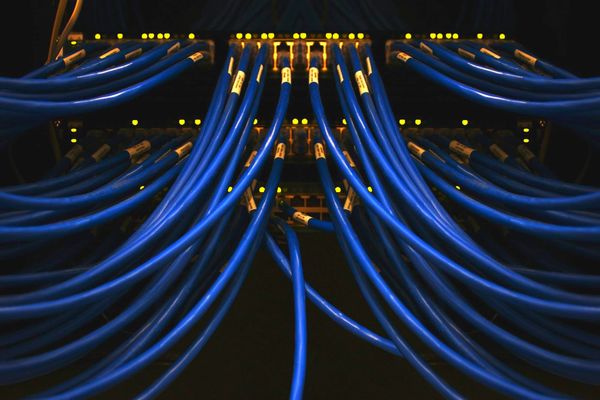
AI Picks and Shovels (Arc 2: Wiring the Mind): Arista Networks (NYSE: ANET) — The Nervous System
Arc 1 built the brains — foundry, custom silicon, merchant challenger. None of it works until the chips talk to each other. This week: the company turning a warehouse of silicon into one thinking cluster; hyperscaler concentration as strength and risk — and Nvidia threat is no longer theoretical.

Three weeks ago this series opened at the foundry that manufactures nearly every advanced chip on the planet. Two weeks ago it moved to the firm that spends that manufacturing capacity building bespoke silicon for six named hyperscalers. Last week it closed with the only company selling a general-purpose GPU off a price list, chasing the incumbent that has owned AI compute for a decade.
All three of those companies build a brain. None of them, on their own, build a cluster. A rack of the best GPUs TSMC can manufacture, customised by Broadcom or challenged by AMD, is still just an expensive collection of bricks until something ties thousands of them together into a single machine that can train one model. That something is not glamorous. It does not appear on a keynote slide as the hero product. It is the switching fabric — and this week, Arc 2 opens with the company that has spent two decades arguing it should be Ethernet, not a proprietary alternative, doing that job.
Arista Networks (NYSE: ANET) does not build a single GPU. It has never needed to. Its bet is that the nervous system connecting the brains is worth as much as the brains themselves — and this year, for the first time, the numbers are starting to agree.
That is where we continue with Arc 2.
ANET — The Nervous System
Without high-speed networking, a data centre is just a warehouse of expensive silicon.
Networking Is Not a Commodity Anymore
For most of computing history, the switch that moved data between servers was a solved problem: buy from Cisco, plug it in, move on. AI training broke that assumption. A large language model training run does not send small, bursty packets the way a website does. It sends enormous, sustained flows between thousands of GPUs at once, every one of which has to arrive in the right order with effectively zero loss — because a single dropped packet can stall a job running across ten thousand chips.
Standard Ethernet, built for web servers and databases, was never designed for that. Neither, for a long time, was Ethernet expected to win the job.
The industry now talks about three different wiring problems, and mixing them up is how the competitive picture gets blurred:
- Scale-up is the network inside the rack, lashing GPUs together so they can share memory. That job is still largely Nvidia’s, through its proprietary NVLink fabric. Arista has said it is not financially relevant to the company until 2027 at the earliest.
- Scale-out is the network that connects racks inside a hall into one training cluster. This is the Ethernet-versus-InfiniBand fight that has defined the last two years.
- Scale-across is the network that ties multiple data centres into one distributed cluster. Arista puts that specific category at $3–4 billion today and $15–20 billion by 2030, including the associated optics.
Nvidia’s own InfiniBand — inherited through its 2019 acquisition of Mellanox — became the default answer for the most demanding AI clusters because it was purpose-built for ultra-low-latency, lossless transport. For years the assumption inside the industry was that AI networking would stay an InfiniBand story, with Ethernet handling everything else.
Arista’s argument, made consistently by chief executive Jayshree Ullal, is that Ethernet was always going to close the gap and then win outright — not on raw latency, where InfiniBand still has an edge, but on cost, openness, and the fact that the rest of a data centre already runs on it. “Ethernet is always the eventual winner and equalizer,” Ullal said earlier this year. 2026 has been the year that argument stopped being a thesis and started being a balance sheet.
Arista’s answer is Etherlink — a family of AI-optimised Ethernet switches, paired with the same Extensible Operating System (EOS) that runs across the company’s entire product line, from a campus box to a high-radix AI leaf. The switching silicon inside those boxes is largely merchant silicon from Broadcom, the custom-chip firm in Arc 1. Arista’s product is the system plus the software: one operating system, one automation layer and one support model from the office network to the training cluster. That is a genuine architectural difference from buying a specialised, siloed InfiniBand fabric that only talks to itself — and it is the cleanest callback in this series so far. Broadcom sells the switch chip. Arista sells the box and the OS that makes a warehouse of those chips behave like one machine.
The pitch to a hyperscaler is not just “buy our box.” It is “run one stack across everything you own.”
The First $3 Billion Quarter
The numbers this year back the argument up. Arista’s second quarter, reported on 4 August, delivered revenue of $3.036 billion — up 37.7% year-over-year and 12.1% sequentially, and the company’s first quarter above the $3 billion line. Non-GAAP earnings per share rose 39.7% to $1.02. Gross margin held at 63.4%. Non-GAAP operating margin was 49.9% — genuinely rare numbers for a hardware business, closer to a software company’s economics than a traditional networking vendor’s.
Management raised full-year 2026 revenue guidance to approximately $12.6 billion, implying 40% annual growth. That was the third guidance raise of the year: $2.1 billion above the $10.5 billion figure set at the 2025 Analyst Day, and $1.1 billion above the $11.5 billion outlook given in May. Inside that guide sit two numbers that matter more than the headline. Arista is targeting at least $3.5 billion of AI-fabric revenue this year, of which scale-across is expected to contribute about $1.2 billion, or roughly 30%. Campus is supposed to deliver at least $1.25 billion. The AI print is the growth engine. The campus and core data-centre book is what stops the whole company from being a pure derivative of two hyperscaler capex cycles.
Cumulative customers running Etherlink AI fabric switches have passed 100, up from four or five when Ullal first flagged the category in 2024. Multi-year purchase commitments — Arista’s own forward orders to component suppliers, not customer purchase orders — nearly tripled over the past year to $9.7 billion, from $3.6 billion. The company says memory supply is now secured through 2027. That last point is not a footnote. The reason a networking company is locking memory is the same scarcity next week’s company sells.
The balance sheet matches the operating picture. Arista holds more than $13 billion in cash and marketable securities and carries no meaningful debt. Concentration risk is real. Solvency risk is not.
Put the growth in context: Arista’s entire 2021 revenue was $2.9 billion. It now does more than that in a single quarter.
The Concentration Nobody Can Ignore
Here is the number every Arista bull has to sit with. In 2025, Microsoft accounted for 26% of revenue and Meta another 16%. Together that is 42%. The broader cloud-and-AI titans group was about 48%. These are not incidental customers. They have been the company’s two largest accounts for years. The latest 10-Q is blunt: two customers accounted for more than 10% of total revenue in each of the last three years. Management’s language on the August call was just as direct: expect one, maybe two additional customers to cross the 10% threshold this year. Microsoft and Meta remain the longest and most committed partners regardless of how the mix shifts.
That concentration is not new, and it has not stopped Arista compounding for a decade. It does mean the growth rate is, to a real degree, a derivative of two companies’ capital-expenditure decisions rather than a broad enterprise upgrade cycle. If either hyperscaler pauses an AI buildout, delays a generation of infrastructure, or shifts meaningful spend toward an alternative fabric, Arista feels it faster and harder than a more diversified vendor would.
The encouraging counter-trend through 2026 has been a third and fourth leg. Oracle and Google are the names analysts most often float as the next 10%-plus accounts. Google’s Virgo fabric deployment is the clearest public marker that a hyperscaler with serious in-house networking capability is still willing to put new AI infrastructure on Arista’s platform. CoreWeave and other specialist AI clouds are growing contributors, which widens the base beyond the traditional club. None of that erases a 42% two-customer print. It does mean the story is no longer a two-name bet in the way it was as recently as 2024.
The Threat With Nvidia’s Name On It
For years the competitive conversation around Arista centred on Cisco — the legacy incumbent Arista spent a decade and a half taking share from, and still the largest player in Ethernet switching when campus, branch and data centre are counted together. In the slice that actually matters for this series, that frame is stale. IDC’s first-quarter 2026 data put Nvidia at 21.5% of data-centre Ethernet switch revenue and Arista at 20.7%. Cisco is no longer the company setting the pace inside the AI hall.
The consequential threat wears Nvidia’s badge. Having conceded, publicly, that AI networking was moving toward Ethernet rather than staying an InfiniBand story, Nvidia did not walk away from the category. It built Spectrum-X: an Ethernet platform designed to port InfiniBand-style ideas — lossless transport, adaptive routing, in-network telemetry — onto Ethernet hardware, then sell that fabric tightly bundled with Nvidia GPUs and BlueField networking silicon.
The share shift is startling, and it is also easy to overstate if the clock and the categories get sloppy. Nvidia held under 4% of the data-centre Ethernet switch market in the first quarter of 2024. By the first quarter of 2026 that share was 21.5%, on $2.1 billion of quarterly switch revenue, according to IDC. That is two years, not one — still one of the fastest vendor-share moves IDC has recorded in enterprise networking. It is not the same thing as Nvidia “owning Ethernet.” The broader Ethernet switch market, campus included, was $15.4 billion in that same quarter, up nearly 40% year-over-year. The data-centre slice was about $10 billion, up 61%. Nvidia’s 21.5% is a share of the second number, not the first.
Nvidia’s wider “networking” line is larger still, because it folds in InfiniBand and the NVLink compute fabric that lives inside the rack. Those dollars matter to Nvidia. They are not all dollars taken from Arista. The overlap that should keep ANET holders awake is Spectrum-X sold into the same scale-out Ethernet builds Arista is chasing — including, on public reporting, parts of Meta’s and Oracle’s infrastructure, and against the backdrop of Meta’s roughly $135 billion 2026 AI infrastructure programme.
This is not a hypothetical risk. It is a company with the deepest pockets and the tightest GPU relationships in the industry, bundling networking into the accelerator sale, already inside two of Arista’s most important accounts.
Arista’s counter is structural rather than purely competitive. It does not need every hyperscaler to buy Arista exclusively. It needs them to keep buying Arista alongside whatever else they run, because vendor-neutral, multi-vendor Ethernet is the entire point of the argument against a vertically integrated Nvidia stack. The Ultra Ethernet Consortium — founded in 2023 with Arista, AMD, Broadcom, Cisco, Intel, Meta and Microsoft as members — exists specifically to keep the AI networking standard open rather than owned by any single silicon vendor, Nvidia included.
Arista’s product-level answer this year is the 1.6-terabit Etherlink generation, including liquid-cooled options aimed at scale-out and scale-across. Those platforms were introduced in 2026; management has them in trials with a handful of large customers in the second half and in production in 2027. Whether an open coalition can out-execute a single company that controls both the GPU and the fabric around it is now the central question in this part of the market. It echoes, almost exactly, the merchant-versus-custom tension that ran through Arc 1.
What the Stock Is Already Pricing
Arista puts the addressable scale-across opportunity at $15–20 billion by 2030. It expects to capture around $1.2 billion of that this year — a line item that barely existed eighteen months ago — on top of the larger scale-out fabric sitting inside the $3.5 billion AI goal. The market behind those figures has become a battleground in its own right rather than a footnote to the GPU story.
The stock has priced in a great deal of that opportunity already. Shares have traded from the mid-$110s to above $210 this year. As of the 18 September 2026 close they sat at about $199, a market capitalisation of roughly US$251 billion, a 52-week range of $114.52 to $214.89, and a year-to-date gain in the region of 50%. Trailing earnings power a multiple in the low sixties; the forward multiple compresses into the mid-forties if the $12.6 billion guide and the associated earnings hold. Those are software-company numbers on a hardware-and-software compounder.
This is a stock priced for the concentration risk to keep resolving in Arista’s favour, for Oracle and Google to keep scaling into genuine 10%-plus accounts, and for the Ultra Ethernet Consortium’s open-standard bet to keep winning enough of the scale-out and scale-across spend against Nvidia’s vertically integrated one. None of those are settled questions. All three are, right now, trending Arista’s way.
The Aussie Angle
Australian investors rarely think about Arista Networks directly, and there is a reasonable argument they should think about it more than they realise — because a meaningful part of the next four years of Arista’s Microsoft relationship is going to be built on Australian soil.
In April this year Microsoft announced a A$25 billion investment in Australian digital infrastructure through to 2029 — its largest-ever commitment to the country, and five times its previous A$5 billion pledge from 2023. The plan is supposed to grow Microsoft’s Australian cloud footprint by more than 140% across 29 data-centre sites spanning three Azure regions, aimed at Azure AI supercomputing and cloud capacity. Microsoft is, on Arista’s own numbers, one of only two customers that reliably clears the 10%-of-revenue threshold.
There is no public disclosure of which switching fabric goes into which Microsoft hall, and Arista does not break out revenue by end-customer location. A $25 billion programme is also not $25 billion of switches: it is capital expenditure, operating expenditure, cybersecurity and skills, of which networking is a sliver. Even so, the mathematics of the relationship make it a near-certainty that some real share of that Australian buildout will run, at least in part, on Arista systems and EOS software.
That is the modern version of a quieter fact. Arista has sold ultra-low-latency switches into financial-market infrastructure since the early 2010s, the same product family built for sub-microsecond packet forwarding on trading floors. The venues Australians use to trade CBA or BHP, and the AI halls Microsoft is expanding in Sydney, Melbourne and Canberra, sit on opposite ends of one company’s line.
For most Australian readers the practical exposure is not a direct ANET line on a CHESS-sponsored holding. Arista pays no dividend, so there is no withholding-tax wrinkle to manage; the currency overlay is simply the AUD/USD print on a US-listed name held through a US broker, a dual-listed access product, or — more commonly — a US index fund or global tech sleeve. The point of knowing the stock is not that every SMSF should own it. It is that the concentration risk sitting at the top of Arista’s 10-K is not an abstraction happening somewhere in Virginia or Iowa. Part of it is being poured in concrete in three Australian cities right now.
The Investment Case — In One Line Per Side
Bull case: Arista holds the software and operational advantage in the fastest-growing segment of AI infrastructure spend, backed by a first $3 billion quarter, 40% guided full-year growth, near-50% operating margins, a net-cash balance sheet, a $3.5 billion AI-fabric target, and a customer base that is starting to look less like a two-name bet and more like a platform, with Oracle and Google the next candidates to join the 10% club.
Bear case: Microsoft and Meta still accounted for 42% of 2025 revenue, and the company across the table is now Nvidia — bundling a rapidly scaling Spectrum-X Ethernet platform into the GPU sale that gave it its hold on AI accelerators, with data-centre Ethernet switch share going from under 4% in early 2024 to 21.5% in early 2026. A low-sixties trailing multiple leaves little room for either the concentration or the competitive risk to break the wrong way.
The honest read: Arista has spent this year proving Ethernet’s economics can scale alongside InfiniBand’s performance, at margins few hardware companies ever reach. What it has not yet proven is that an open, multi-vendor coalition can consistently out-compete a single company that controls both the compute and the fabric wired around it. Nvidia has just shown, over two years rather than one, how fast it can move when it decides to try.
Arc 2 Opens
TSM built the brains. AVGO customised them. AMD challenged for the crown. Now the brains have somewhere to talk — Arista’s Ethernet fabric is what turns ten thousand isolated chips into a single machine that can actually train something. A connected brain still needs somewhere to store what it learns. That is why Arista is already buying memory through 2027.
Next Monday’s company started in a dentist’s office basement, in a city better known these days for a river greenbelt and a blue football field than for semiconductors. It survived decades of boom-and-bust cycles that wiped out nearly every other Western competitor in its category, became only the latest American company to cross a trillion-dollar market capitalisation this year, and now makes a category of chip that every AI cluster on the planet needs and that only two other companies on Earth — both South Korean — know how to build at real scale.
Data Sources:
- Arista Networks Q2 2026 earnings release, 10-Q and earnings call, 4 August 2026; FY2025 10-K (customer concentration)
- IDC Quarterly Ethernet Switch Tracker, Q1 2026
- Fierce Network interview with Jayshree Ullal, January 2026; Fierce Network and Network World, 2026
- Nvidia FY2026 and subsequent quarterly networking disclosures
- Ultra Ethernet Consortium founding membership, 2023
- Microsoft Australia infrastructure announcement, April 2026; Bloomberg
- Reuters and SMH coverage
- Market data as of 18 September 2026 close
Wall St. Down Under | Australia
Subscribe | wallstdownunder.com.au
Disclaimer: Wall St. Down Under is an independent financial newsletter for informational and educational purposes only. Nothing published here constitutes financial advice, a recommendation to buy or sell any security, or a solicitation of any investment decision. Always do your own research and consult a licensed financial adviser before making investment decisions. Australian investors should consider their own financial situation, objectives, and risk tolerance. Past performance is not indicative of future results.