Editorial: NVIDIA’s Leather Jacket Discount: Life After Jensen
Berkshire built a succession machine; Apple telegraphed its handoff. Now NVIDIA co-founder Jensen Huang has resigned amid a foreign-intelligence probe, DOJ inquiries and a reported relationship, leaving CFO Colette Kress as interim CEO. What Australian holders should weigh.

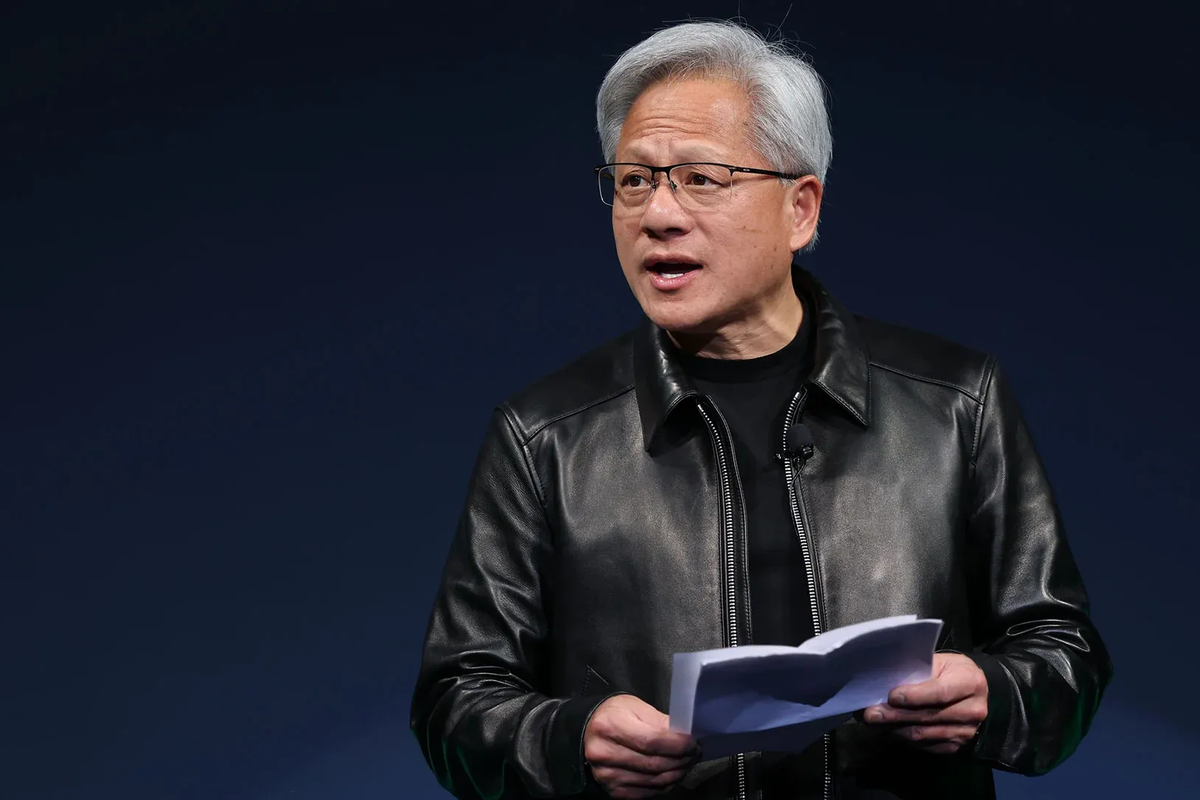
Breaking update. NVIDIA announced on Thursday (US time) that co-founder Jensen Huang has resigned as president, chief executive officer and board member, effective immediately. Executive Vice President and CFO Colette Kress has been appointed interim CEO while the board launches a formal search for a permanent successor, and longtime director Harvey C. Jones has been named NVIDIA’s first-ever chair. Check live quotes before placing orders.
Ticker & venue: NASDAQ: NVDA (no ASX listing)
Leadership transition: Jensen Huang stepped down effective immediately; CFO Colette Kress is serving as interim CEO alongside her finance duties while the board considers internal and external candidates.
Price & market value: Shares fell roughly 10% to 13% in Thursday’s US session following the announcement, extending a steep drawdown from the 6 October record close (US$239.24) and wiping roughly US$800bn from the company's market value this week.
Multiple: Compressing sharply from roughly 31x trailing earnings in July (and 47x in January) on US$303.0bn of trailing revenue and a 63.7% net margin.
Catalysts: Q3 FY27 earnings on Tuesday 17 November (Wednesday 18 November, 9:00am AEDT); a congressional request for Huang to appear before lawmakers on 18 November; and ongoing DOJ, FBI and independent board investigations.
Australian exposure: Roughly 7.1% of ASX-listed ETFs IVV and NDQ, direct US brokerage holdings, and many super fund growth options.
1. Three Ways to Price a Founder
Over the past four months in Stock Spotlight, we have tracked how America’s largest companies price the person in the chief executive’s chair.
- Berkshire Hathaway (NYSE: BRK.B). In The Berkshire Thread (Part 3), Warren Buffett handed the CEO role to Greg Abel and moved to an advisory seat. Berkshire is a decentralised capital-allocation machine designed to run at the same speed regardless of who sits at the top.
- Apple (NASDAQ: AAPL). In The $4.5 Trillion Question Under New Management, Tim Cook’s handoff to John Ternus was telegraphed, layered and absorbed by the institution.
- SpaceX & Tesla (SPCX / TSLA). In The SPCX–TSLA Megamerger, Elon Musk turned key-man risk into a permanent, visible discount that investors price every day. (Elon Musk posted on X that it “would be an honor” to hire Huang.)
NVIDIA sat in a fourth category. It traded with a founder premium. For 33 years Huang served as co-founder, chief architect, lead salesperson to the hyperscalers and the company’s chief diplomat in Washington and Beijing. The market priced a US$4+ trillion franchise as if that role were permanent.
Now, after three decades, the market has its answer: the founder is gone, and investors must price NVIDIA on its institutional strength alone.
2. What Happened
8 November (US time): the national-security question. NVIDIA’s board announced an independent investigation, overseen by independent directors and outside counsel, after reports that Huang was the target of a foreign intelligence effort. The board initially said it had no reason to believe national security or NVIDIA’s secrets were compromised, and expressed confidence in Huang. In a staff email the same day, Huang said he had fallen short and would cooperate fully. He acknowledged infidelity but did not name anyone.
Reporting by outlets including The New York Times, NBC and CNBC links the matter to Alice Huang (also known as Huang Le), a former executive of Singapore-based Megaspeed, a significant buyer of NVIDIA’s advanced chips. The reports say U.S. officials assess her to be a Chinese intelligence asset. She is not related to Jensen Huang. These are reported assessments, not court findings; China’s Foreign Ministry has dismissed the claims as unsubstantiated, and Singapore’s government has said it did not investigate her alleged ties. NVIDIA hired Wachtell Lipton to lead the probe.
11–12 November: a second report, and an abrupt exit. The New York Times reported, citing five people who worked at NVIDIA, that Huang also had a relationship with Kimberly Powell, NVIDIA’s vice president of healthcare, who reports directly to him. The reporting included an alleged March incident at the company’s GTC conference. Neither NVIDIA, Huang nor Powell confirmed those claims. Following an emergency board meeting that ran late Wednesday night, NVIDIA disclosed via an SEC filing and press release on Thursday morning that it had accepted Huang’s resignation from all executive and board roles, effective immediately.
The wider fallout:
- Interim leadership: CFO Colette Kress, who joined NVIDIA in 2013 after finance roles at Microsoft and Cisco, steps in as interim CEO while keeping her CFO responsibilities. Board member Harvey C. Jones, former CEO and chair of Synopsys, becomes NVIDIA’s first-ever board chair.
- Department of Justice and FBI inquiries: Alongside President Trump’s statement that the FBI is examining the ties, The Wall Street Journal and Reuters report that the US Justice Department is leading multiple investigations involving Alice Huang, following an earlier Commerce Department probe.
- Congressional scrutiny: Three House Republican committee chairs formally asked Huang to appear for a private session with lawmakers on 18 November—the day after NVIDIA reports Q3 FY27 earnings.
- Shareholder litigation: A class action was filed earlier this week alleging concealment of the relationship and misleading statements about national-security concerns, building on questions raised in a May short-seller report regarding Megaspeed’s closeness to NVIDIA.
3. The Precedent Test: Succession Decides the Outcome
When a chief executive exits over personal conduct, investors reach for precedent. The closest cases involve CEOs removed over relationships with colleagues: Intel in 2018 and McDonald’s in 2019.
The outcomes diverged. By one analysis, Intel trailed the S&P 500 by about 17 percentage points over the following year, while McDonald’s beat the index. The difference was a ready successor. Where the next leader was credible and in place, shareholders kept their multiple. Where the seat was contested, they did not.
By that test, NVIDIA faces a steep climb:
- An interim caretaker, not a designated heir. While Kress is a seasoned financial operator who understands the business deeply, she is holding down two demanding jobs during a global search. NVIDIA’s famously flat structure, with roughly 60 executives reporting directly to Huang, meant no obvious operational number two was waiting in the wings.
- A national-security overlay. Intel and McDonald’s faced governance questions. NVIDIA faces them alongside DOJ and FBI inquiries, congressional scrutiny and a foreign-intelligence investigation touching a major customer and its export-licence environment. Huang’s departure removes the lightning rod, but the regulatory perimeter governing NVIDIA’s China revenue remains under intense pressure.
- Direct-report liability. Retaining outside counsel to examine a relationship with a subordinate created immediate board-level exposure alongside an active shareholder class action. By moving swiftly to accept Huang’s resignation and install an independent chair, the board has tried to ring-fence governance risk—though legal fallout will take time to clear.
4. The Valuation Math: Pricing NVIDIA Without the Founder Premium
The market’s immediate verdict is clear: with Huang out, the founder premium has evaporated, compressing NVIDIA’s valuation multiple well below the roughly 31x trailing earnings it commanded in July (and 47x in January). A lower multiple on exceptional margins is only a bargain if those margins and growth rates hold up under new leadership. Three factors will dictate where the multiple settles:
- Replacing the central hub. Huang was the architect of a flat organisation and the chief salesperson to the hyperscalers. Kress and the senior engineering team can run supply chains, capital returns and near-term product rollouts, but a permanent CEO will need to replicate Huang’s authority over multi-year customer roadmaps.
- The Washington discount. China data-centre optionality has flipped from a possible upside to a regulatory overhang, with lawmakers citing the episode to demand tighter oversight of chip routing.
- Next week’s earnings test. Kress’s first major public test arrives in days, when NVIDIA reports Q3 FY27 results on Tuesday 17 November (Wednesday 18 November, 9:00am AEDT). Reassuring guidance on Blackwell/Rubin demand and hyperscaler orders will be critical to putting a floor under the stock.
The bull case deserves a fair hearing. CUDA lock-in, the order book and hyperscaler capital-expenditure commitments have not changed overnight. NVIDIA has the same chips and customers it had a week ago, and Wedbush analyst Dan Ives has argued that a dislocated price creates a buying opportunity even without Huang. With Huang’s exit now confirmed, two main paths frame the road ahead:
|
Scenario |
What happens |
What it implies |
|
Clean handoff & strong Q3 |
Kress steadies the ship on 17 Nov; board names a credible permanent CEO quickly; probes stay contained |
Closest to the McDonald’s outcome: a reset multiple, then fundamentals decide |
|
Drawn-out search & regulatory drag |
CEO search stalls; DOJ/congressional inquiries or litigation escalate; hyperscalers accelerate second-sourcing |
Closest to the Intel outcome: a persistent governance discount and rising competitive risk |
5. What Australian Holders Should Weigh
For Australians investing in America, NVIDIA is rarely a single line on a brokerage statement. As we outlined in The Great Concentration Trap, mega-cap winners quietly dominate passive portfolios.
- Hidden index exposure. Even if you have never bought NVDA directly, it accounts for roughly 7.1% of both the ASX-listed iShares Core S&P 500 ETF (ASX: IVV) and the BetaShares NASDAQ 100 ETF (ASX: NDQ), sitting second only to Apple, and features heavily in growth-oriented super options. Check your fund’s latest factsheet to see your true weighting.
- Selling has an Australian tax cost. Selling direct holdings crystallises a capital gains tax event. Individuals who held the shares for more than 12 months get the 50% CGT discount, while super funds get a one-third discount. The AUD/USD conversion spread applies on the way out. Position size is a better guide than overnight headlines.
- Time-zone trap. Major announcements are landing in Australia’s morning and trading reacts overnight (regular US hours run 1:30am to 8:00am AEDT). Limit orders and pre-set rules beat reacting to a stale quote.
- Second-order beneficiaries. In AI Picks and Shovels, we noted that hyperscalers have spent two years looking for a credible second source. A prolonged leadership transition helps custom-silicon partner Broadcom (NASDAQ: AVGO) and merchant rival AMD (NASDAQ: AMD). Foundry bottleneck TSMC (NYSE: TSM) is largely insulated regardless of whose name sits on the chip design.
The Bottom Line
Great businesses survive bad headlines, and NVIDIA’s technology lead will not vanish overnight. What has gone—definitively now—is the founder premium that came with Jensen Huang’s 33-year tenure.
Berkshire showed that a company can be priced without its icon when succession is built in advance. Apple showed that a telegraphed handoff keeps the multiple. NVIDIA did not get the luxury of a planned transition. With Colette Kress in the interim seat and Tuesday’s Q3 earnings looming, NVIDIA now has to prove it can follow McDonald’s playbook rather than Intel’s.
Data Sources:
Company and market data
- NVIDIA Newsroom, NVIDIA Announces CEO Transition (12 Nov 2026)
- NVIDIA, Statement from the Board of Directors (8 Nov 2026): https://investor.nvidia.com/news/press-release-details/2026/Statement-from-NVIDIA-Board-of-Directors/default.aspx
- NVIDIA, Q3 FY2027 Financial Results Announcement Schedule (17 Nov 2026): https://investor.nvidia.com/events-and-presentations/events-and-presentations/default.aspx
- CNBC, Huang staff email and board statement (8 Nov): https://www.cnbc.com/2026/11/08/nvidia-jensen-huang-email-board-of-directors-statement.html
- Google Finance, Yahoo Finance and Macrotrends, NVDA price, trailing/forward P/E, TTM revenue and net margin data
Reporting on Huang’s resignation, the board, DOJ and Congress
- ABC News Australia, Breaking: Nvidia founder Jensen Huang quits as CEO (13 Nov 2026)
- CNBC, Nvidia CEO Jensen Huang resigns, Colette Kress named interim chief (12 Nov 2026)
- Bloomberg, Huang, Face of the AI Boom, Ousted by Nvidia Board as CEO (12 Nov 2026)
- The Wall Street Journal, Jensen Huang Has Been Ousted as Nvidia CEO (12 Nov 2026)
- CNBC, board meeting and New York Times report on Kimberly Powell (11 Nov): https://www.cnbc.com/2026/11/11/nvidia-jensen-huang-affair-employee.html
- ABC News (US), House committee request for 18 November appearance: https://abcnews.com/US/nvidia-board-reportedly-preparing-oust-ceo-jensen-huang/story?id=138062059
Megaspeed and Alice Huang
- CBS News, Megaspeed ties, class action and FBI comment: https://www.cbsnews.com/news/megaspeed-nvidia-china-ties/
- Axios, Alice Huang profile (9 Nov): https://www.axios.com/2026/11/09/alice-huang-nvidia-jensen-megaspeed
- CNBC, Megaspeed explainer (9 Nov): https://www.cnbc.com/2026/11/09/megaspeed-nvidia-jensen-huang-alice-huang.html
Precedents, valuation and Australian ETF weights
- Yahoo Finance, Intel (2018) and McDonald’s (2019) comparison: https://finance.yahoo.com/markets/stocks/articles/nvidia-board-reportedly-preparing-oust-233419551.html
- BlackRock Australia (iShares Core S&P 500 ETF — IVV) and BetaShares (NASDAQ 100 ETF — NDQ) portfolio holdings factsheets (Nov 2026)
Wall St. Down Under archive
- The Berkshire Thread (Part 3) (3 Aug 2026)
- AAPL — The $4.5 Trillion Question Under New Management (1 Jun 2026)
- Special Edition: The SPCX–TSLA Megamerger (7 Jul 2026)
- The Great Concentration Trap (6 Nov 2026)
- AI Picks and Shovels series (Aug–Sep 2026)
Wall St. Down Under | Australia
Subscribe | wallstdownunder.com.au
Disclaimer: Wall St. Down Under is an independent financial newsletter for informational and educational purposes only. Nothing published here constitutes financial advice, a recommendation to buy or sell any security, or a solicitation of any investment decision. Always do your own research and consult a licensed financial adviser before making investment decisions. Australian investors should consider their own financial situation, objectives, and risk tolerance. Past performance is not indicative of future results.